
Compatibilizer Masterbatch for PE/PP Recyclates
Compatibilizer and adhesion promoter masterbatches for polyolefin recyclates such as PE and PP. They combine different recycled plastics to help achieve PPWR recycled-content targets at near-virgin performance levels and without additional capital investment.
Manufacturers seeking to increase recycled content without risking customer complaints face a fundamental challenge: PE and PP in mixed recycling streams are mechanically incompatible. A custom-formulated compatibilizer masterbatch from Granula enables significantly higher PCR (post-consumer recycled) content while keeping impact strength, elongation at break, and processing stability close to virgin-material levels.
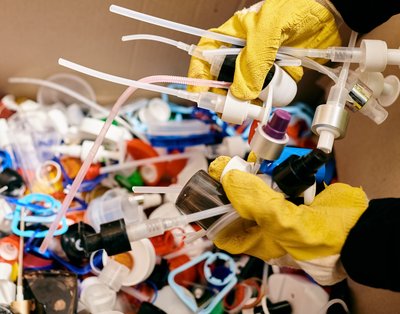
The challenge of working with recycled polymers
“We need to increase our recycled-content share, but our parts no longer meet performance requirements.”
This is a statement we currently hear from plastics processors across virtually every market segment. The root cause is almost always the same: PE/PP multiphase systems. Even highly sorted rHDPE typically contains 3 - 15 % PP, while PP recyclates regularly contain PE originating from labels, film lids, and closures.
At the molecular level, the two polymers are incompatible: in the melt they form coarse dispersed droplets, and failure initiates at the phase boundaries under mechanical load. The consequences are recognized late: brittle fracture, premature fatigue, and customer complaints that often emerge only weeks after delivery.
What the Granula® compatibilizer masterbatch solves
Adding 2 - 3 % of compatibilizer to the recyclate typically addresses three problems that currently block higher PCR usage:
1. Compliance with product specifications – even at substantially higher recycled content. Impact strength, elongation at break, and environmental stress crack resistance (ESCR) generally remain close to virgin-material levels.
2. Reduction of scrap and customer complaints. A finer phase morphology means fewer local weak points, fewer brittle failures in the field, and fewer warranty claims.
3. Utilization of challenging recyclates. Mixed recyclates that would otherwise be incinerated or downcycled can become specification-compliant again for high-value parts.
The compatibilizer is dosed on your existing extrusion and injection-molding equipment. So no riquirement of additional investment capital.
Most common applications of compatibilizers
PE-stream variant: For rHDPE bottles, PE films, and HDPE compounds with PP contamination. Depending on the recyclate stream, improvements in elongation at break of up to a factor of 2 - 3 and impact strength gains of 80 % or more are achievable – we determine the actual values on your material. This can bring rHDPE back into the bottle-to-bottle loop for non-food applications or into technical packaging.
PP-stream variant: For rPP compounds and PP injection-molding recyclates containing PE. Can significantly improve low-temperature impact resistance at –20 °C (in favorable cases +100 %), typically with a moderate reduction in stiffness. This opens applications in automotive interior parts, household appliances, and logistics components.
Because every recyclate stream is different, we formulate each compatibilizer customer-specifically. Granula deliberately offers no off-the-shelf standard grade.
Results from the field – application examples
- Packaging converters can increase PCR content in HDPE bottles from 30 % to 50 % or more without missing top-load or ESCR specifications, an important building block for PPWR compliance.
- Automotive and industrial injection molders can increasingly replace virgin PP with rPP compounds while continuing to meet OEM low-temperature impact specifications.
- Film manufacturers can process mixed PE recyclates into technical films for construction and agriculture that are often not reliably producible without compatibilization.
- Compounders achieve more stable MFR and mechanical properties from mixed recyclate streams.
What differentiates Granula® from standard market solutions
For more than 30 years, we have developed masterbatches for leading European packaging and industrial customers. What sets us apart:
- Custom formulation instead of a standard grade: Every compatibilizer is matched to your specific recyclate stream (compatibility agent, phase mediator, or combined reactive solution).
- Trial support including mechanical testing: Charpy, tensile, and MFR testing on your application recyclate, with before-and-after comparison, working directly with our R&D team instead of receiving an anonymous datasheet.
- No intentionally added PFAS: Free of fluorinated processing aids; conformity supported on request by an analytical certificate (target analysis).
- Masterbatch grades with food-contact conformity available: EU, FDA, China. Whether the recyclate in the final product may be used for food contact is governed by EU Regulation 2022/1616.
- Swiss made: Short delivery routes within EU/EMEA, certified to ISO 9001 and ISO 13485.
- PPWR documentation: Declarations of conformity and design-for-recycling evidence.
PPWR – the window for action is closing
The EU Packaging and Packaging Waste Regulation (PPWR, EU 2025/40) introduces mandatory recycled-content requirements from 2030 onwards – between 10 % and 35 % depending on the application, rising to as much as 25 % - 65 % by 2040. Anyone still producing with low PCR content must convert within the next 36 months: those who qualify now have time for internal trials, customer approvals, and line optimization. Compatibilization is therefore a key technical measure for maintaining the mechanical performance..
Frequently Asked Questions about compatibilizer masterbatches (FAQ)
What dosage does a compatibilizer masterbatch require?
Typically 2 – 3 % in the final compound. The exact dosage depends on the recyclate stream and is determined on your material as part of our trial support.
Does compatibilization work for rHDPE with an unknown PP content?
Yes. Even highly sorted rHDPE may contain 3 – 15 % PP.
Do I need new equipment?
No additional capital investment required.
Is the compatibilizer suitable for food contact?
Masterbatch formulations compliant with EU, FDA, and China regulations are available. Whether the recyclate in the final product may be used for food contact is governed by EU Regulation 2022/1616; mechanically recycled polyolefins are currently approved for food contact in the EU only in exceptional cases.
Why are there no standard grades with datasheets?
Because every recyclate stream is different. A one-size-fits-all product cannot deliver consistent results with varying PCR qualities. We formulate customer-specifically and verify performance with mechanical testing on your material.
Granula® – the specialists in compatibilizer masterbatch for PE/PP recyclates
© Granula AG. Last update: June 17, 2026
Author: Sulo Zendeli, CEO / MAS Polymer Engineering